Wondering: Where is the self?
So…where is the self? Can anyone really find it?
In group recently, we were talking about the relationship between behaviors, emotions, and thoughts. Each one influences the others, and the influence goes both ways. One idea that came up was that we have emotions, but we are not our emotions. We can experience a feeling, but that feeling does not define who we are. It’s possible to step back and notice the feeling in the body and mind, observing it rather than becoming it.
The same idea applies to thoughts. We have thoughts, but we are not our thoughts. Thoughts can be observed as they come and go—almost like leaves floating down a river. There goes a yellow one… and then it’s gone. Thoughts arise, and given enough time, they pass.
So that leaves behaviors. Behaviors are things we do. They are often influenced by our emotions and our thoughts. But are we simply the sum of our behaviors? I don’t think so. Behaviors can change, and they are often temporary. Think of something you’ve done in the past—something good or something you regret. Does that one action define you forever? Most of us would say no. People grow, learn, and move forward.
Then there are our values, which make things even more interesting. Values influence our thoughts, emotions, and behaviors. We can ask ourselves: Are my behaviors aligned with my values? Are my thoughts aligned with my values? Sometimes they are—and sometimes they aren’t. When our thoughts drift away from our values, they can influence behaviors that don’t reflect who we want to be.
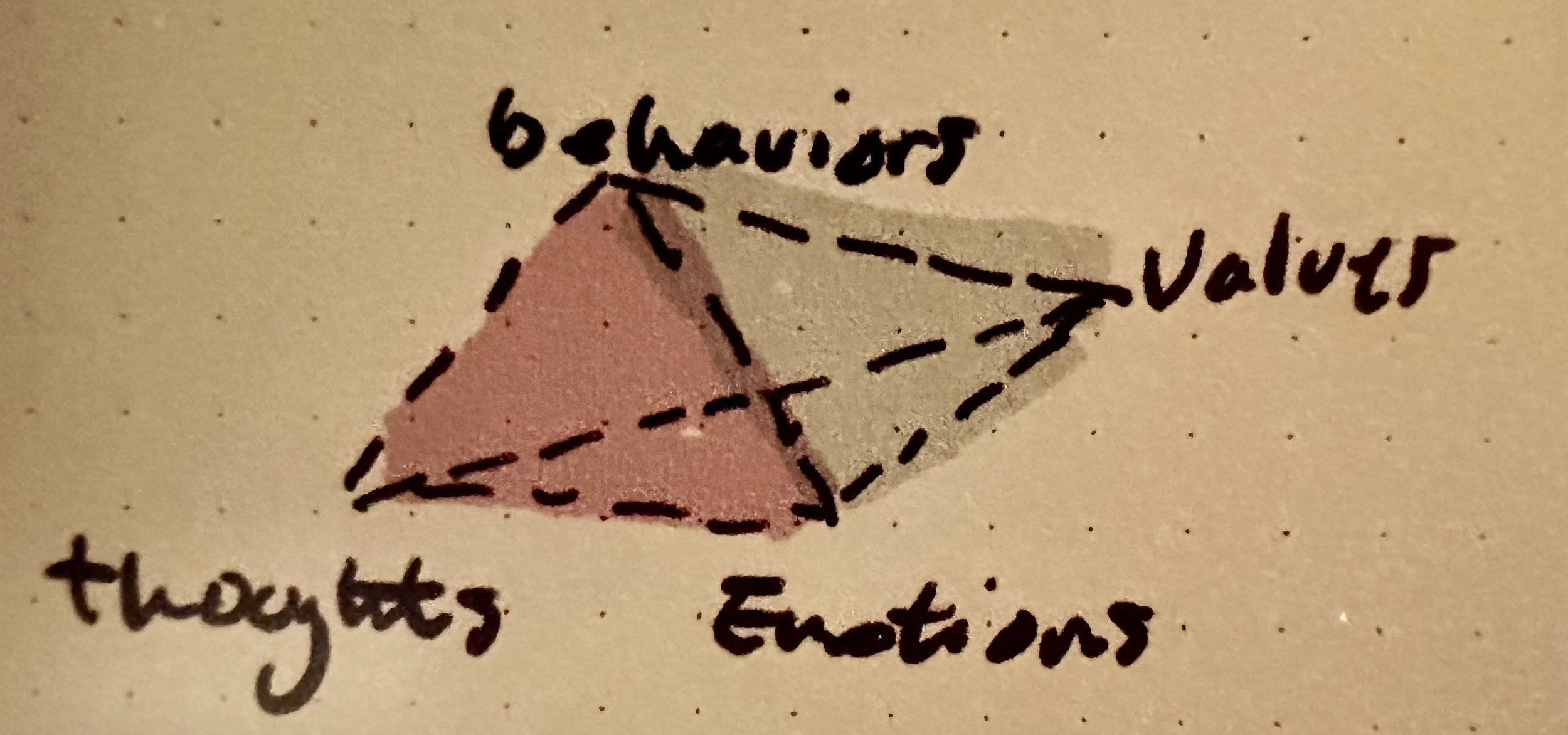
In group, we pictured it like this: the traditional DBT triangle shows how thoughts, emotions, and behaviors influence one another. That’s a two-dimensional model, but we expanded it a bit. We imagined values connected to each corner of the triangle. The connections were like dotted lines—almost like bungee cords—flexible and able to move. Why? Because values can shift over time, and so can our thoughts, emotions, and behaviors. None of these things are completely fixed.
Which brings me back to my original question: where is the self in all of this?
Who is the one observing the thoughts, emotions, and behaviors? Who is the one noticing whether they align with our values? And who is choosing those values in the first place?
It seems that some part of us can observe, decide, and choose. Some people call this the authentic self—the driver of the bus that carries our values, behaviors, thoughts, and emotions along the road.
But that leads to another question: how do we find that self? And how do we work with our authentic self if we can’t quite locate it?
Just something I’ve been thinking about. More later…