I told Brittani
I told Brittani that I was okay.
I told Brittani that everything was fine.
I told Brittani that I didn’t need help.
I told Brittani that I could make it through.
I told Brittani that I would be back.
I told Brittani that I was safe.
I told Brittani that I wouldn’t hurt myself.
I told Brittani that everything was out of the house.
I told Brittani that I wouldn’t do it.
I told Brittani that everything is locked up.
I told Brittani that I wouldn’t end it today.
I told Brittani that I can do it alone.
I told Brittani that I wondered if it was worth it.
I told Brittani that I would see her on Monday.
I will, won’t I?
Maybe.
back where I started
So…I am home from residential treatment, and in many ways, it feels like I’ve landed right back at square one. The strange part is that I’ve changed a lot, but home hasn’t. The same stressors, the same environment, and the same pain that sent me to treatment are all still here waiting for me.
I came home with new skills, new insight, and the beginning of healing. I’ve started to work through some incredibly difficult things. But something still feels off, like a piece of me hasn’t caught up yet. Maybe that missing piece is simply learning how to exist outside the safety of treatment.
The adjustment has been harder than I expected. With that, difficulty has come intense anxiety, and when my anxiety gets high, it often brings persistent thoughts of self-harm and suicide along with it. A really terrible combination.
This week, I started a new Partial Hospitalization Program (PHP) focused on trauma. I think it will be a good bridge between residential treatment and outpatient therapy. It gives me structure, support, and a place to continue doing the work. Still, I’ve found myself minimizing how bad things really feel.
On my daily check-in sheets, I note that I’m struggling with these thoughts, and I’ve already had a couple of conversations about safety. The staff means well, and I know they care. But I’m terrified that if I fully tell the truth about how often these thoughts show up, I’ll be sent right back to inpatient or residential treatment. So I soften it. I downplay it. I say enough to be honest, but not enough to feel dangerous.
At home, we’ve taken steps to keep me safe. My medications are locked up, and there are no sharps in the house. But today I had to pick up a prescription refill from the pharmacy: a bottle with 130 pills in it.
I sat there staring at that bottle for an hour.
Part of me wanted to take them, and admitting that fills me with shame and guilt. But I didn’t do it. Somewhere inside all the noise and fear and pain, there was still a small part of me fighting to stay. Right now, that small part feels worth holding onto.
More later…
Links-a-go-go
Here are some helpful links and phone numbers:
988 - National Suicide Lifeline
www.988lifeline.org911 - Emergency
1.800.Don’t.Cut - Self-harm Support Hotline
1.800.SUICIDE - hotline for people contemplating suicide
1.800.334.HELP - Self-injury Foundation’s 24-hour crisis line
1.866.488.7386 - The Trevor Project LGBTQIA+
www.thetrevorproject.orgwww.findahelpline.com - Find a helpline
Maladaptive Schemas Quiz - The Attachment Project
www.linehaninstitute.org - The Linehan Institute (DBT)
https://dialecticalbehaviortherapy.com Dialectical Behavior Therapy (DBT)
What is Cognitive Behavior Therapy - Mayo Clinic PDF
Cognitive Behavior Therapy - Mayo Clinic
Cognitive Behavior Therapy - American Psychological Association
Cognitive Behavioral Therapy - American Psychological Association PDF
Borderline Personality Disorder - Mayo Clinic
Borderline Personality Disorder - National Institute of Mental Health
The Great Dialectic
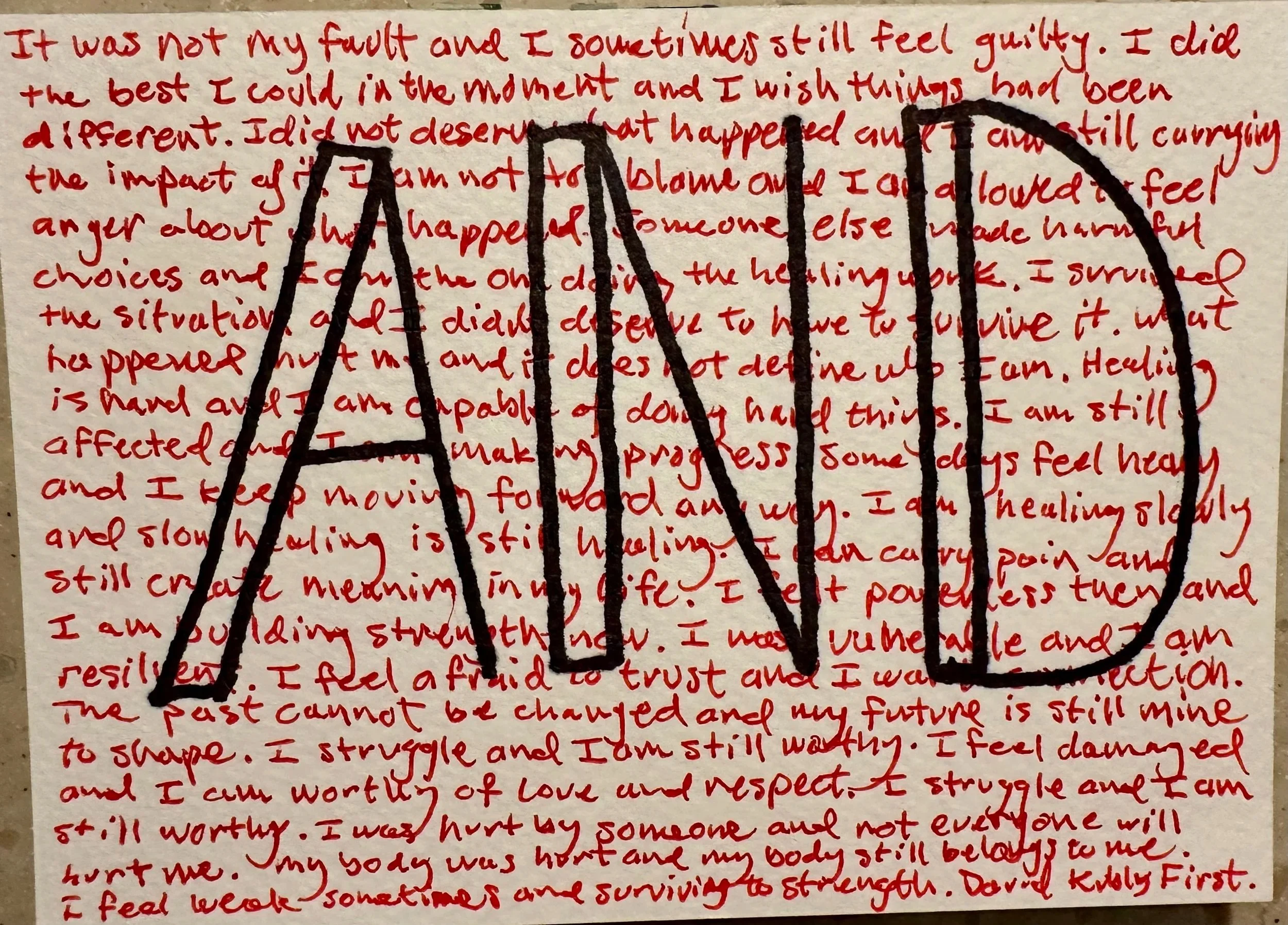
At the heart of Dialectical Behavior Therapy (DBT) is a simple but transformative idea: the word “and.” It’s a small word, but it holds immense power. “And” allows two truths to exist at the same time. It doesn’t erase, minimize, or replace one feeling with another—it makes room for both. In that space, healing can begin.
For me, this concept has been life-changing.
When I was 13, I experienced sexual assault. The impact of that moment didn’t stay in the past—it followed me, shaping years of depression, anxiety, and internal struggle. For a long time, my experiences felt all-consuming, as if there was only room for pain.
But through treatment, I’ve begun to understand the power of “and.”
I can acknowledge what happened to me and recognize that I am still here.
I can feel pain and allow moments of peace.
I can carry my past and move toward healing.
This idea—this dialectic—has given me something I didn’t have before: permission to be okay, even while holding difficult truths. It doesn’t erase what I’ve been through, but it changes how I live with it.
“And” didn’t fix everything. But it gave me a way forward.
It was not my fault and I sometimes still feel guilty.
I did the best I could in that moment and I wish things had been different.
I did not deserve what happened and I am still carrying the impact of it.
I am not to blame and I am allowed to feel anger about what happened.
Someone else made harmful choices and I am the one doing the healing work.
I survived the situation and I didn’t deserve to have to survive it.
I feel strong and I feel deeply hurt.
I feel angry and I feel sad.
I feel numb sometimes and I also feel overwhelmed at times.
I feel shame and I know the shame does not belong to me.
I want to forget and I want to be understood.
I feel broken sometimes and I am still whole as a person.
I feel scared and I am learning ways to feel safe again.
I lost control in that moment and I am regaining control now.
I felt powerless then and I am building strength now.
My body remembers the fear and my body can also learn safety again.
I feel unsafe sometimes and I am learning how to protect myself now.
I was vulnerable and I am resilient.
What happened hurt me and it does not define who I am.
Healing is hard and I am capable of doing hard things.
I am still affected and I am making progress.
Some days feel heavy and I keep moving forward anyway.
I am healing slowly and slow healing is still healing.
I am allowed to struggle and I am allowed to grow.
I can carry pain and still create meaning in my life.
I feel afraid to trust and I want connection.
I feel guarded and I still care deeply about others.
I was hurt by someone and not everyone will hurt me.
I feel distant sometimes and I am capable of closeness.
My body was hurt or violated and my body still belongs to me.
I feel disconnected from my body sometimes and I am learning to reconnect.
I feel shame about my body and my body deserves care and kindness.
I feel uncomfortable in my body and I can learn to feel safe in it again.
I feel weak sometimes and surviving took strength.
I judge myself harshly and I am learning to be compassionate with myself.
I feel damaged and I am worthy of love and respect.
I feel alone at times and I am not alone in my healing journey.
I struggle and I am still worthy.
The past cannot be changed and my future is still mine to shape.
I carry memories and I am not trapped in them.
I feel afraid of the future and I am taking steps forward anyway.
I have been hurt and I can still build a meaningful life.
More Later…
On my way
So…There’s something surreal about leaving a place that has held you together for weeks.
Today, I’m on my way home. I left the treatment facility at noon and now I’m sitting at the train station, waiting for the next leg of the journey. It feels like a transition in every sense of the word—not just physically, but emotionally too. I’m carrying a lot with me as I leave: gratitude, uncertainty, pride, and, if I’m being honest, a bit of fear.
I have mixed feelings about going. On one hand, I’m genuinely excited to be home, to step back into my life and reconnect with the world outside of treatment. On the other hand, it’s hard to leave behind a place that has been so safe and supportive. The people I met here—especially the other residents—became an important part of my daily life. There’s something uniquely powerful about going through something difficult alongside others who truly understand. I’ll miss that more than I can easily put into words.
But this isn’t the end of the work—it’s just the next phase. I’m moving into a trauma-focused partial hospitalization program, and I know there’s still a lot ahead of me. That’s both intimidating and grounding. It reminds me that healing isn’t a single moment or a finished milestone—it’s a process that unfolds over time.
More than anything, I want to take a moment to say thank you. To the people who supported me throughout this experience: you showed up for me in ways that mattered deeply. I leaned on you—sometimes heavily—and you met me with care, patience, and consistency. That kind of support is not something I take lightly. It made a difference in ways I’ll carry with me long after today.
I wouldn’t be where I am right now without that support. And while I’m stepping forward into something new, I’m doing so with a stronger foundation than I had before.
So here I am—somewhere between where I’ve been and where I’m going next. Waiting for a train, yes—but also, in a way, learning how to move forward. More later…
Almost
So…I have about a day and a half left at this residential treatment facility. It’s hard to believe that after two months here, I’m almost at the finish line. During this time, I’ve learned so much about myself and developed a toolbox full of DBT skills that I know will continue to help me long after I leave.
Even with all of that growth, I feel a little nervous about going home. Here, I’ve had support and care around the clock. The environment has been intentionally safe—no sharps, constant supervision, and people available whenever I needed help. That level of safety has allowed me to focus on healing, learning, and practicing new ways to cope.
Lately, though, as my discharge date gets closer, I’ve noticed my anxiety increasing—and with it, my urges. I’m doing everything I can to resist those thoughts and not give in to them. It feels like the closer I get to leaving, the louder those internal struggles try to become.
Another patient and I were talking about this recently. She shared something that stuck with me: when you’re almost out, the demons try to claw you back harder than ever. It’s a powerful image, and in many ways, it feels true. This final stretch isn’t just about waiting to leave—it’s about being resilient and staying committed to the progress I’ve made.
I’m leaning heavily on the skills I’ve learned here. I know these thoughts and urges may not disappear entirely, but they don’t have to control me. I can keep them at bay. I can sit with discomfort, use my coping strategies, and remind myself that I am stronger than the urges that try to pull me backward.
This last day and a half feels both exciting and intimidating. It marks the end of one chapter and the beginning of another—one where I take everything I’ve learned and apply it in the real world. That thought is scary, but it’s also empowering.
More later…
A day helps
So…I have been struggling with anxiety due to changes in my medical insurance. When I first learned about the change, my mind immediately went to worst-case scenarios. That’s a pattern I know well—my brain tends to assume catastrophe before I have all the facts.
I’ve now had a day to sit with the anxiety and think more clearly about how this is going to work. The reality is that I have been fortunate. My insurance has helped pay for my stay at this residential treatment facility, which I am incredibly grateful for. It’s also important to remember that I am not losing insurance coverage altogether. I simply need to complete the COBRA paperwork and pay the premium to continue my coverage.
Even knowing this, the anxiety and worry still show up. That catastrophic thinking creates a lot of stress, and it’s something I recognize as an area I need to keep working on. This is another opportunity to practice the skills I’ve been learning—pausing, looking at the facts, and reminding myself that not every problem is a disaster.
More later…
5 days to go
So…I have five days left in my treatment program. I’ve learned a lot and made significant progress. However, I found out yesterday that unexpected things can still throw me off balance.
I learned that my health insurance will end at the end of this month, and I will need to apply for COBRA coverage. This will reset my insurance, and I will have to pay my $1,500 deductible again. This situation has caused a lot of anxiety.
I am scheduled to start my next program on Tuesday, May 5, 2026, but I’m not sure how that will work. My COBRA insurance will be retroactive to May 1, 2026, but I won’t have paperwork to prove coverage right away. I don’t know if they will allow me to start the program without proof of insurance, or if I will have to wait until I receive the actual insurance card.
This entire medical leave process has been stressful and confusing. It feels like nobody has clear answers, and I’m left in the dark wondering how I will pay my bills. I applied for the Minnesota Paid Leave program and for long-term disability. My Minnesota Paid Leave benefits were approved, but HR says the leave dates may be incorrect, and I might have to repay some of the benefits. My long-term disability was supposed to begin on March 27, 2026, but they are still determining whether I qualify.
It all feels very overwhelming and makes my anxiety worse. I am in a depression and anxiety treatment program and trying to focus on my recovery, but these issues make that very difficult. I’m doing my best to sit with the anxiety and breathe through it, but it keeps building.
More later…
Nine Days to go
So…here’s a quick update. I have been in the program for almost seven weeks, and I am scheduled to be discharged next Thursday. During this time, I have learned many distress tolerance and emotional regulation skills. According to my doctor and therapist, I have made progress in all aspects of my treatment.
I, on the other hand, feel nervous about going home and leaving this safe, structured environment. I know that eventually I have to return to my life and start putting things back together. Maybe it’s not about picking up where I left off, though—that wasn’t working for me. Instead, I need to reevaluate what was working and what wasn’t. I need to advocate for myself and build on the things that were helping.
It’s going to be a challenge. Another important thing to remember is that there is another person in this equation—my husband. How can we rebuild our life together? That is the million-dollar question.
More later…
Past Patient M
Dear Past Patient M,
Things around here just aren’t the same without you. Every once in a while, I see you out on a walk, and it reminds me of the conversations we shared and the time we spent together on the unit. Sitting in the cafeteria and sipping my coffee feels lonely now.
I hope you’re finding the help you need on your new unit, and I hope you’re doing well. I miss you. If you ever need someone to talk to or need anything, you know where to find me.
Take good care of yourself,
David
A new art project
So…I recently finished my last art project and was given a new one to create. This time, I started by reviewing my treatment goals. After that, I met with the art therapist to discuss them, and she assigned me a new project called The Coping Wheel of Emotions.
The goal of this project is to find a balance between ten emotions—five distressing emotions and five goal emotions. For each distressing emotion, I need to identify two coping skills to help manage it. For each goal emotion, I’m supposed to choose two behavioral activations—actions that could help bring about that feeling.
The emotions also need to be represented visually by blending three elements such as color, shape, size, pattern, texture, symbols, images, or words. Finally, everything has to be arranged in a way that shows how the emotions are related to each other.
At first, I started by choosing emotions from an emotion wheel and trying to balance them as opposites. But the process felt cold and impersonal. So I decided to take a few liberties with the rules and focus instead on emotions I actually experience. That changed everything.
I ended up identifying thirty emotions that feel real and relevant to me. Then I ranked them from the ones I feel most often to the ones I feel least. From there, I came up with the idea of creating an accordion-style book that would display the emotions from most to least felt.
To show the intensity of each emotion, I plan to use color shading across the top of the pages, moving from dark to light. Emotion number one will be the darkest, representing the strongest intensity, while emotion number thirty will be the lightest. Each page will include words that define the emotion, along with the required coping skills or behavioral activations. I’ve also created a unique symbol to represent each emotion.
I chose to use six-inch by six-inch square pages. What I didn’t realize at first is just how long thirty six-inch pages become when connected together—really long. That also means the book will end up being very thick. I may need to adjust my plan a bit as I move forward.
Thankfully, I still have time to work on it and figure out the details. I didn’t expect this project to be such a big undertaking, but it’s definitely going to be a challenge. At the same time, I think it has the potential to turn into something really meaningful—and maybe even something pretty cool.
I’ll upload pictures when it’s finished. More later…
The latest update
So…I know it’s been a while since I last posted. I’ve been going through some really challenging things lately, and that has left me feeling drained and overwhelmed. Much of the trauma in my life happened during my teenage years. I know that was a long time ago, but I bottled up those feelings for 43 years, and it takes a huge effort to finally bring them into the light.
Feelings of shame and guilt are hard enough to deal with on their own, but when they’ve been repressed for so long, it becomes an even greater challenge. These feelings started breaking through and caused me a great deal of anxiety and depression. As much as I tried to keep them at bay, I just couldn’t.
My therapist and I have been digging into these thoughts and feelings, and I’ve been using a strategy called Thought Challenging to explore my negative thoughts and emotions. This strategy helps bring cognitive distortions to light and allows me to reframe negative thoughts into more balanced and positive ones. It’s not an easy strategy to use—it takes effort and practice.
In addition, I’ve been working on self-compassion. I’ve realized that I am often not kind to myself and tend to use a lot of negative self-talk. As I’ve continued working on this, I’ve noticed that my self-talk has started to become somewhat kinder.
I am still experiencing feelings of depression and anxiety, but their severity is gradually decreasing. I still have troubling urges, but they are happening less frequently than before. I continue to make progress, even though sometimes it’s slower—and harder—than I expected.
But I’m going to keep working on it. More later…
A new painting
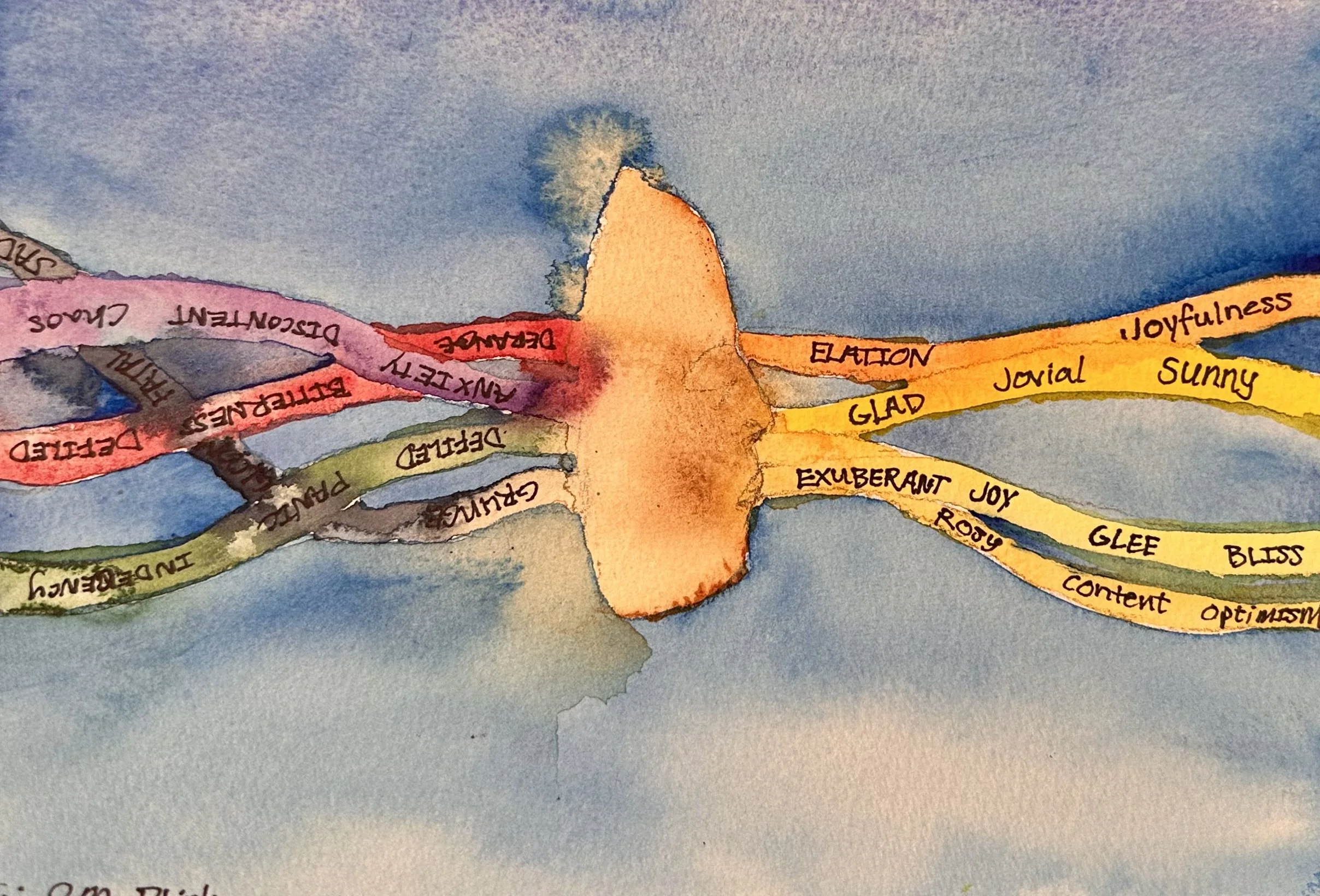
So…Here is my latest painting. It is watercolor and sharpie on watercolor paper. So I’ve been playing with the motif of a mask. The masks we all wear. The inner and outer masks. The outer is what we portray to people and the inner is what we keep to ourselves. I find that I wear a mask and I can’t let my guard down. I can’t let anyone in. It is one of my treatment goals, to start to let people in. To represent myself as I am and not put on the happy mask is a huge challenge for me. I’m starting to begin the process. Wish me luck. More later…
A New Painting
So…I’ve been doing art therapy throughout my stay in residential, and it has become one of my favorite activities. This particular project, however, was created during open art time. During open art, we’re allowed to create anything we want using the materials available.
I chose to make a painting and worked on it over several open art sessions. It has become one of my favorite pieces.
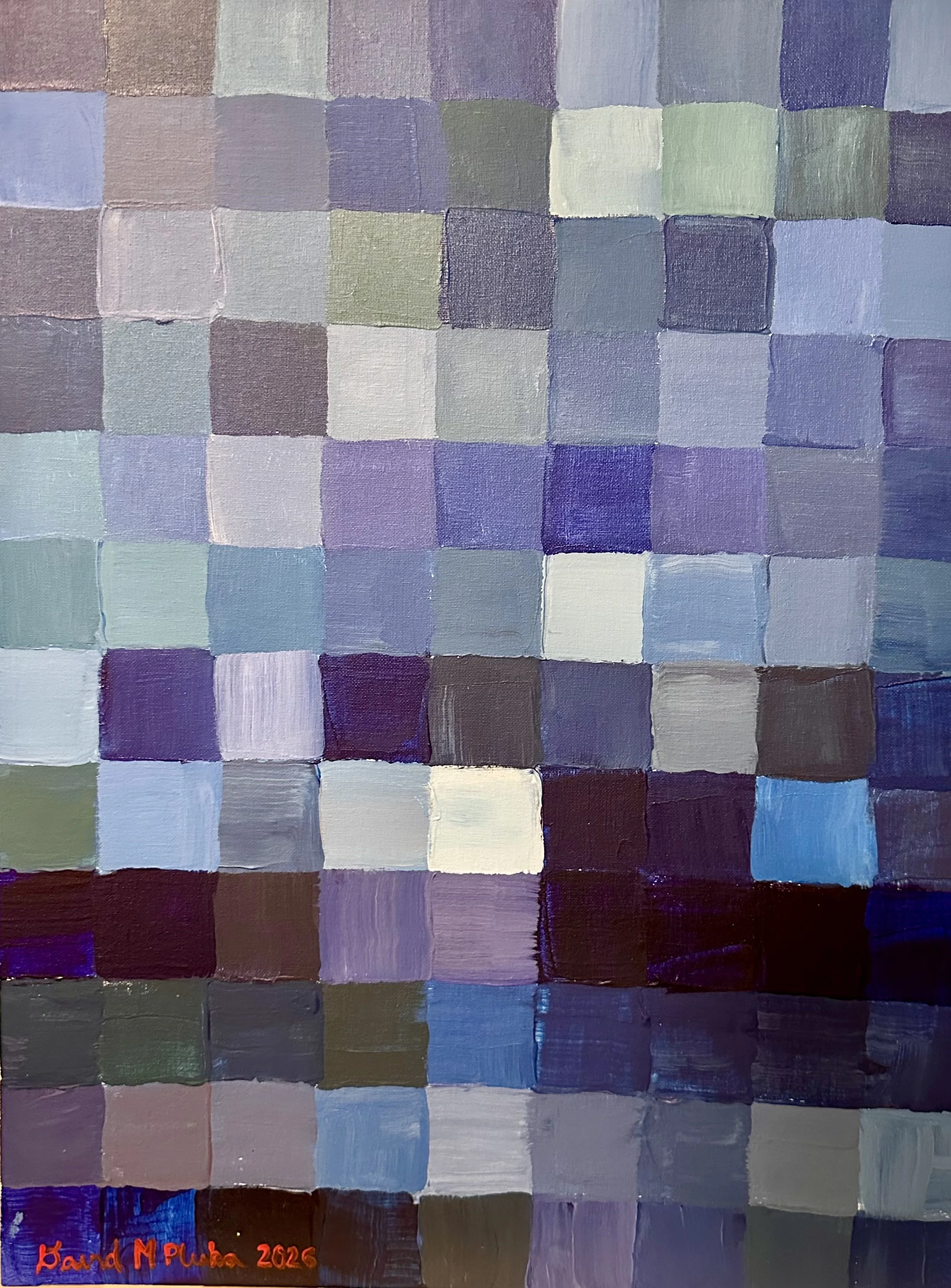
To begin, I divided the canvas into small squares and painted each one a different shade of blue. I tried to make every square unique. The color blue represents sadness, and the variety of blues represents how everyone’s sadness is different, yet similar—because they are all still shades of blue. Since they are all connected by the same color, they reflect how our experiences of sadness connect us to one another. Everyone feels sadness from time to time. The lighter shades represent milder sadness, while the darker blues represent sadness that feels deeper and more intense. Here it is. More later…
I have schemas????
So…I have been doing some work on schemas. A schema is a cognitive framework that plays an important role in how our existing knowledge interacts with new information. Schemas work subconsciously to evaluate the information we encounter every day. Most of the time, we are unaware of how they operate, yet they strongly influence how we perceive our surroundings and the people in them.
Some schemas work well, while others can be a major hindrance. Schemas allow our brains to take “shortcuts” when interpreting the vast amount of information we take in. That sounds helpful, right? Well, not always. Sometimes these cognitive frameworks cause us to ignore important information and focus only on details that support our preexisting beliefs and biases. This can make it difficult to gather and retain new, useful knowledge about the world around us.
Schemas are also resistant to change, which means it can take significant effort to reshape them. Schemas are not necessarily negative, but some are considered maladaptive. Most people have several schemas—some serve us well, and others do not.
There is a helpful survey that can identify personal schemas. I took the assessment and learned that I have several maladaptive schemas. Here are my top four:
Negativity/Pessimism
Defectiveness
Social Isolation
Failure
Among several others, these are the ones that stood out most. I will go through them one by one.
Negativity/Pessimism
This schema can develop in children whose parents are depressive or negative, or in children who experience severe adversity early in life. It is characterized by seeing the glass as half empty—focusing on the negative side of life, expecting things to go wrong, and engaging in catastrophic thinking.
Defectiveness
This schema can develop when a child grows up in a rejecting environment. It is characterized by the belief that something is seriously wrong with you, along with low self-esteem and feelings of being defective or unworthy of love and respect. It often includes strong feelings of shame or embarrassment about perceived flaws and fear that those flaws will be exposed.
Social Isolation
This schema can develop when a child grows up in an isolated environment or feels different from others in meaningful ways. It is characterized by the belief that you do not belong anywhere, feeling different or disconnected, expecting rejection or criticism, and experiencing social anxiety.
Failure
This schema can develop when parents do not encourage independence, goal-setting, or the development of skills and confidence. It is characterized by the belief that you have failed, will fail, or are currently failing at life. It includes feelings of inadequacy, incompetence, and low self-confidence, along with strong negative emotions related to perceived failure.
I do not write about these schemas to blame my parents. Many factors influence how schemas develop. Family environment is one factor, but genetics and experiences outside the family also play important roles.
I am at the beginning of challenging these maladaptive schemas, and I know I have a long way to go. It will take time, effort, and persistence. Right now, I feel like I am standing at the bottom of a huge mountain, preparing to climb it one step at a time.
More later…
So what’s in a name
So…I’ve been working closely with my doctor to better understand what’s going on and to adjust my medications. Getting an accurate diagnosis is important because it helps guide the direction of treatment. Right now, my diagnoses include:
Major Depressive Disorder, recurrent, severe
Generalized Anxiety Disorder
Trauma and PTSD
Borderline Personality Disorder
That’s a lot to carry. My therapist explained that trauma can often contribute to both depression and anxiety, so addressing the trauma directly may help ease those symptoms. We’ve started that work, and it’s incredibly difficult. I’m revisiting feelings and experiences I’ve kept buried and haven’t shared with anyone. But I know that bringing them into the open is an essential step toward healing, even though it feels overwhelming.
At the same time, we’re adjusting my medications. We’re working to taper off one medication because the side effects outweigh the benefits, and the plan is to replace it with something new. We’re also trying to improve my sleep, since I’ve been waking up around 4:00 a.m., which is very early for me.
All of these changes are happening while I’m processing trauma, which has left me feeling emotionally fragile. At times, it’s felt like I’m slipping into a downward spiral. I’m grateful to be in a safe, supportive environment, because outside of it, I might have acted in ways that could have harmed me. I’m doing my best to manage the thoughts and feelings, even though they still come up.
This is a difficult journey. But I am in a safe place. I am in a safe place. I am in a safe place.
More later…
Some Trouble
So…things don’t always go according to plan, and with mental health, the path can feel especially complicated. It’s easy to get thrown off course and end up somewhere really difficult. That’s what happened to me last Sunday.
I was feeling very anxious and tried a technique to calm myself. It helped a little at first, but then a wave of other emotions surfaced and completely overwhelmed me. I started crying and found myself thinking I was a failure, along with strong urges to harm myself and thoughts of suicide. It took a long time for things to begin settling down.
One of the Mental Health Technicians stayed with me the entire time, gently talking me through it. Being in a safe environment—without access to anything I could use to hurt myself—made a real difference.
The experience really scared me. It came on so quickly and felt like a tornado, with painful thoughts spinning so fast I couldn’t think clearly. In that moment, all I could believe was that I was a terrible person who deserved to be punished. I felt breathless, disoriented, my heart racing, and an overwhelming sadness.
I’m still here, but I’m struggling. I’m very grateful to Sarah for her kindness and care. More later…
Day No. Ten
So… I haven’t quite managed to keep up with a daily blog post. Instead, I’m adjusting my expectations and planning to write once or twice a week—maybe three if things line up. My goal is simply to keep you, dear reader, updated on how things are going.
Today I met with my therapist, and together we set some goals for the time I’m here. One goal is to practice being more vulnerable—sharing my thoughts, feelings, and desires more openly. Another is to begin working through some of the trauma I’ve been carrying and suppressing. We’re also focusing on reducing the impact of depression and anxiety. These things don’t simply disappear, but it is possible to learn ways to manage them more effectively. They’re not small goals by any means.
We’re also making adjustments to my medications so they better align with both my genetics and FDA guidelines. Some of the medications I’m taking affect my system in a way that makes the dosage act much stronger than it appears, while another is actually above the typical recommended amount. The plan is to rebalance things and find a more appropriate combination. Since I’m in a safe and supportive environment, this feels like the right time to make those changes—it’s certainly better than trying to manage it all at home.
Today I also had art therapy, which is easily my favorite class here. I sometimes walk in feeling very anxious, but the act of making art helps me settle down and lowers that anxiety.
Right now I’m working on a mask. The outside represents the emotions I show to the world, while the inside represents the feelings I tend to keep hidden. The exterior is painted a deep blue. The interior is currently black with a large red scar running through it. I’m thinking about adding cracks to the blue outer surface, though I’m still deciding what else might happen on the inside.
I’ll share a photo when I’m able.
Wondering: Where is the self?
So…where is the self? Can anyone really find it?
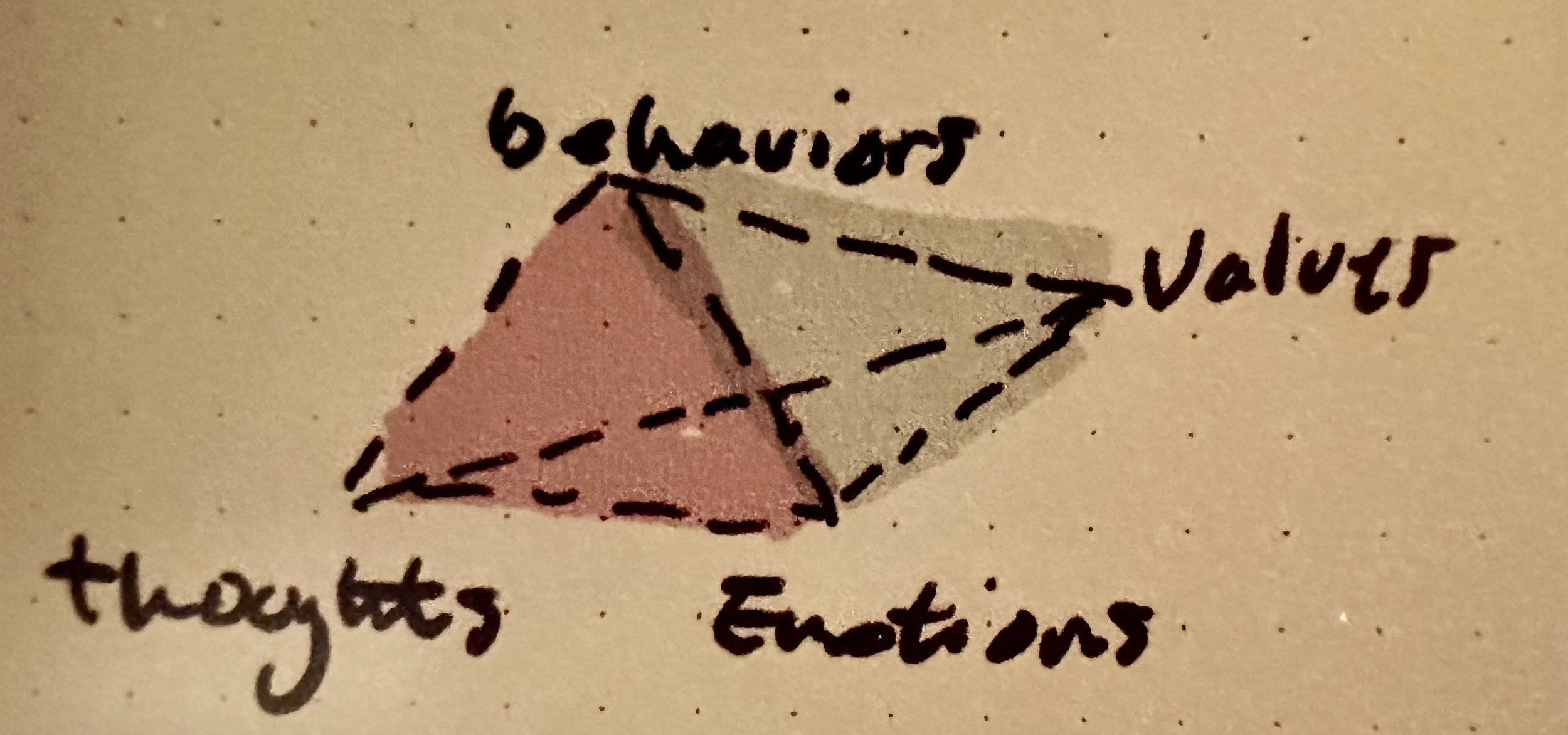
In group recently, we were talking about the relationship between behaviors, emotions, and thoughts. Each one influences the others, and the influence goes both ways. One idea that came up was that we have emotions, but we are not our emotions. We can experience a feeling, but that feeling does not define who we are. It’s possible to step back and notice the feeling in the body and mind, observing it rather than becoming it.
The same idea applies to thoughts. We have thoughts, but we are not our thoughts. Thoughts can be observed as they come and go—almost like leaves floating down a river. There goes a yellow one… and then it’s gone. Thoughts arise, and given enough time, they pass.
So that leaves behaviors. Behaviors are things we do. They are often influenced by our emotions and our thoughts. But are we simply the sum of our behaviors? I don’t think so. Behaviors can change, and they are often temporary. Think of something you’ve done in the past—something good or something you regret. Does that one action define you forever? Most of us would say no. People grow, learn, and move forward.
Then there are our values, which make things even more interesting. Values influence our thoughts, emotions, and behaviors. We can ask ourselves: Are my behaviors aligned with my values? Are my thoughts aligned with my values? Sometimes they are—and sometimes they aren’t. When our thoughts drift away from our values, they can influence behaviors that don’t reflect who we want to be.
In group, we pictured it like this: the traditional DBT triangle shows how thoughts, emotions, and behaviors influence one another. That’s a two-dimensional model, but we expanded it a bit. We imagined values connected to each corner of the triangle. The connections were like dotted lines—almost like bungee cords—flexible and able to move. Why? Because values can shift over time, and so can our thoughts, emotions, and behaviors. None of these things are completely fixed.
Which brings me back to my original question: where is the self in all of this?
Who is the one observing the thoughts, emotions, and behaviors? Who is the one noticing whether they align with our values? And who is choosing those values in the first place?
It seems that some part of us can observe, decide, and choose. Some people call this the authentic self—the driver of the bus that carries our values, behaviors, thoughts, and emotions along the road.
But that leads to another question: how do we find that self? And how do we work with our authentic self if we can’t quite locate it?
Just something I’ve been thinking about. More later…
Day No. 6
So…Saturdays here feel a little different from the usual weekday routine.
This morning we had an outing and drove to a local thrift store. We had hoped to go to a bookstore, but there was an accident on the highway, so our plans changed. I ended up finding a few great pieces—J.Crew jeans, a KÜHL jacket, and some Banana Republic shorts—and spent very little money. A little retail therapy every now and then can be a good thing. It was also just nice to get out for a while.
We also had some work time and group. During group we played Contexto, which is a really fun word game. For the last activity of the day, we did karaoke. I had never done karaoke before, but I gave it a try and sang three songs—very much out of key the whole time. It was still a lot of fun. A few people here can really sing, which made it even more enjoyable to listen to.
Now we have some free time. I’m planning to read for a bit and then head to bed early. I’m still waking up at four in the morning—ugh! The upside is that it gives me some quiet time to write letters. At that hour no one else is up, and the silence is actually quite nice.
More later…